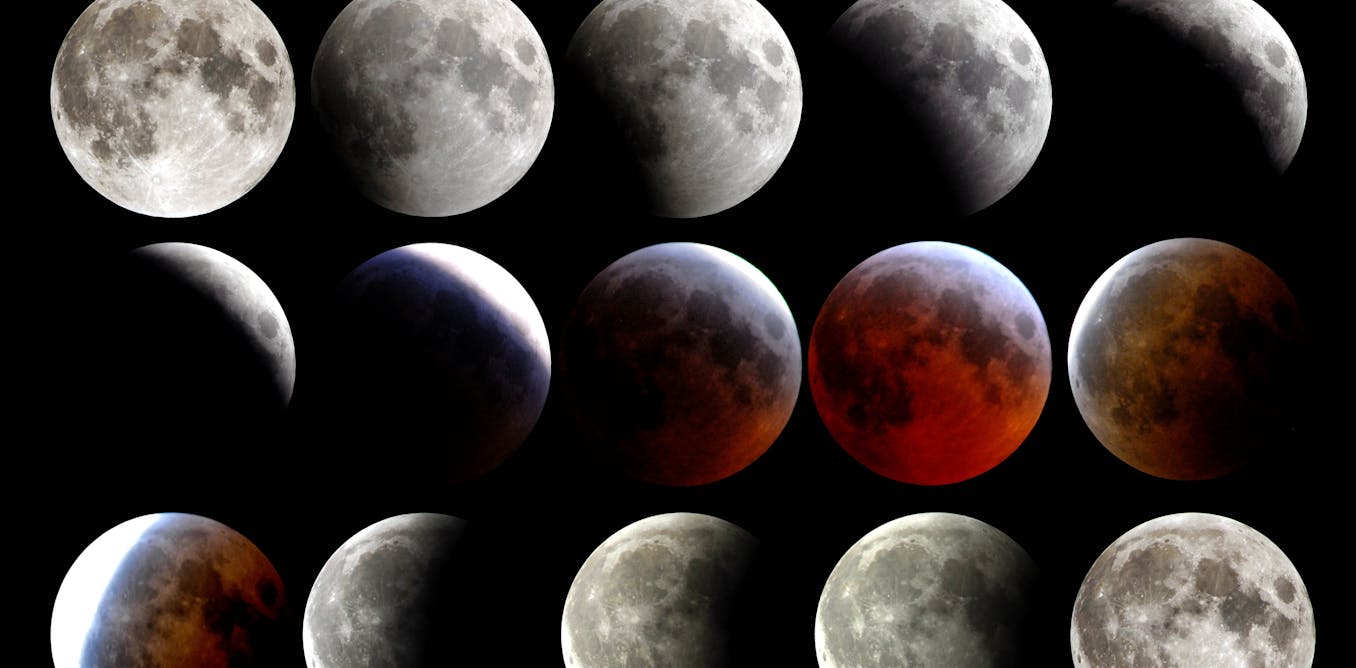
The first lunar eclipse of 2021 is going to happen during the early hours of May 26. But this is going to be an especially super lunar event, as it will be a supermoon, a lunar eclipse and a red blood moon all at once. So what does this all mean?
If you're looking to the stars and want to make sure you're not in stuck in the dark then check out this interesting article just published in The Conversation by MSU's Shannon Schmoll.
And if you're a journalist looking to cover this most interesting lunar event then let us help.
Shannon Schmoll is the director of the Abrams Planetarium at Michigan State University and an expert on basic astronomy, naked-eye astronomy, eclipses, constellations, and the night sky. Shannon is available to speak with media regarding this event – simply click on her icon now to arrange an interview today.
·
2 min
As the world continues to turn during the COVID-19 pandemic, many of us are settling in for a holiday season unlike any other in recent memory. One that, on its face, seems to lack the usual magic of holidays in the past.
That would be the case, if not for the once-in-a-lifetime great conjunction that will occur on Dec. 21. A great conjunction that many are calling the “Christmas Star.” Shannon Schmoll, director of the Abrams Planetarium at Michigan State University, offers her insight on the astronomical event that will be sure to brighten the holidays. An astronomical conjunction occurs when any two heavenly bodies appear to pass or meet each other as seen from Earth. To make one “great,” though, requires an encounter between our solar system’s two largest planets. The orbits of Jupiter and Saturn align to allow the giant worlds to seemingly convene roughly every 20 years.
However, some great conjunctions are, well, greater than others. The slightly oval shape of Jupiter and Saturn’s orbits, and how inclined each orbit is with respect to the sun’s equator, causes the planets’ closeness in the sky to fluctuate across their cyclic conjunctions. During some great conjunctions, the two worlds appear to come so close as to practically hug each other; during others, they seem to approach no nearer than arm’s length. (Of course, the planets are never actually close at all; during their December 21 encounter, they will still be separated by more than 730 million kilometers.) This coming conjunction is an event that’s getting a lot of attention and a lot of scientists, star-gazers and reporters looking up and looking to know more. December 17 – Scientific American
So, if you are a journalist covering this rare event – then let our experts help.
Shannon Schmoll is the director of the Abrams Planetarium at Michigan State University and an expert on basic astronomy, naked-eye astronomy, eclipses, constellations, night sky. Shannon is available to speak with media regarding this event – simply click on her icon now to arrange an interview today.
·
2 min
The scientific world is abuzz and it’s all because of a recent discovery around Venus.
Just this week, an international team of astronomers detected the chemical compound phosphine in the atmosphere of the planet that is second from the sun.
The breaking news has many looking toward the sky and speculating what it all might mean.
“This discovery is interesting because phosphine can be a tracer for microbial life on other worlds and life is the only known explanation for what we know about Venus,” says Shannon Schmoll, the director of the Abrams Planetarium at Michigan State University. “However, the detection overall is faint and Venus is a world with many unknowns. So, if the detection is indeed confirmed, then we need to first rule out there aren't some other unknown processes that could result in this gas first before we can say there are indeed alien microbes out there. Either way, there's something strange going on in Venus's atmosphere that scientists need to figure out and warrants further exploration.” There’s a lot still to find out and a lot more to be understood about this most recent discovery, and if you are a journalist looking to cover this emerging story – then let our experts help with your questions and stories.
Shannon Schmoll is the Director of the Abrams Planetarium at Michigan State University. She is an expert on basic astronomy, naked-eye astronomy, eclipses, constellations, night sky and is available to speak to media regarding this story – simply click on her icon now to arrange an interview today.
Media
Biography
Shannon Schmoll is the director of the Abrams Planetarium at Michigan State University. She has worked on expanding our audience and finding new ways if utilizing our immersive planetarium theater. She has a PhD in astronomy and science education. Her dissertation was titled "Toward a Framework for Integrating Planetarium and Classroom Learning" and was aimed at better understanding how planetarium field trips can effectively fit into formal astronomy curriculum. She also has completed a certificate in Museum Studies which included a 3-month internship at the Adler Planetarium in Chicago where she worked on exhibit content development, exhibit design, and creating materials for educators. She is currently guiding the planetarium in the development of engaging and interactive astronomy programming including full dome shows and exhibits and building partnerships with various groups on the MSU campus and the greater Lansing and Michigan communities.
Industry Expertise
Writing and Editing
Education/Learning
Research
Areas of Expertise
Night Sky
Eclipses
Basic Astronomy
Planetariums
Science Education
Naked-Eye Astronomy
Constellations
Education
University of Michigan
Ph.D.
Astronomy and Science Education
2013
University of Michigan
M.S.
Astronomy and Astrophysics
2009
University of Washington
B.S.
Astronomy and Astrophysics
2007
Affiliations
Great Lakes Planetarium Association
News
Telescope sales and stargazers are both looking up these days
The Christian Science Monitor Daily online
2020-12-18
The pandemic makes astronomy a fitting hobby. People can do it alone in their backyard. But it also offers ways to connect with others virtually, as people post their astrophotography on social media and share celestial experiences at a time when they can't be physically together. Furthermore, the night sky itself can be a unifying view, says Shannon Schmoll, director of the Abrams Planetarium at Michigan State University. “Right now, we're all separated. We don't get to see our families right now. We don't get to see our friends. We don't get to see other people. But all over the world, everyone sees the same stars,” she says. “And so we have that shared experience by going outside to look up … and that is something that can connect us.”
MSU ABRAMS PLANETARIUM GRANT TO FUND METEORITE DISPLAY
MSU Today online
2017-10-18
“The display will feature meteorites found from around the world but will put front and center the Michigan meteorites in our collection, a little piece of our state’s own ‘space heritage’ so to speak,” said Abrams Planetarium Director Shannon Schmoll...
A Guide to Conducting Educational Research in the Planetarium
Planetarium
2015 For the past several decades, researchers have conducted studies on the planetarium as an educational venue. A major goal of this research has been to measure student conceptual learning (e.g. Brazell & Espinoza, 2009), while other studies have compared learning outcomes in the planetarium to learning in other settings (e.g. Zimmerman, Spillane, Reiff, & Sumners, 2014).
Toward a Framework for Integrating Planetarium and Classroom Learning
Deep Blue
2013 Field trips are a ubiquitous part of modern school programs and can offer exciting, engaging, and authentic experience for students to learn science. There has been extensive research on how to best integrate field trips with classroom instruction so they can reach their full potential. Planetaria are often ignored in this literature, which is unfortunate as they are more didactic and structured environments than other informal spaces such as museums, but can still offer positive affect and learning gains to students outside of the classroom.
Mobile learning in museums: how mobile supports for learning influence student behavior
Proceedings of the 10th International Conference on Interaction Design and Children
2011 Nomadic scientific inquiry -- technology-supported authentic inquiry done on-the-go, across settings -- has the potential to engage students in learning new concepts and practicing essential science skills. We developed the Zydeco system to support nomadic inquiry in part through enabling the collection and annotation of multimodal data (photographs and audio notes). The system was designed to bridge school and museum contexts through project-based science inquiry. In this study, we explore how Zydeco influences student behavior and sensemaking in the museum.
How students find, evaluate and utilize peer-collected annotated multimedia data in science inquiry with zydeco
Proceedings of the SIGCHI Conference on Human Factors in Computing Systems
2010 Scientific inquiry can be more authentic and meaningful to students when using personal and peer-collected data. The challenges of organizing and evaluating a potentially large amount of data can be overcome through the use of annotations (title, tags, and audio notes). We created Zydeco, a multi-component system that students use to collect annotated multimedia data from a museum (using a smartphone app), and then create a scientific explanation with their personal and peers' data (using a tablet app). We ran a classroom study with 54 students (ages 11-13) investigating how students searched for, evaluated, and used annotated data to construct a scientific explanation. We found that tags supported data interpretation, while title searching and panning through the unfiltered data set supported finding and using data.
Using tags to encourage reflection and annotation on data during nomadic inquiry
Proceedings of the SIGCHI Conference on Human Factors in Computing Systems
2010 Nomadic inquiry may benefit from tagging when used for educational purposes to support reflection and annotation during data collection. To that end we created Zydeco, a mobile system to scaffold learners through the science inquiry process in and out of the classroom, and tested it in a museum with 42 middle school students. Students report that tags encouraged reflection and annotation during data collection, suggesting that tagging can be used to support nomadic inquiry. From this work we present some emerging design recommendations for constructing similar systems.