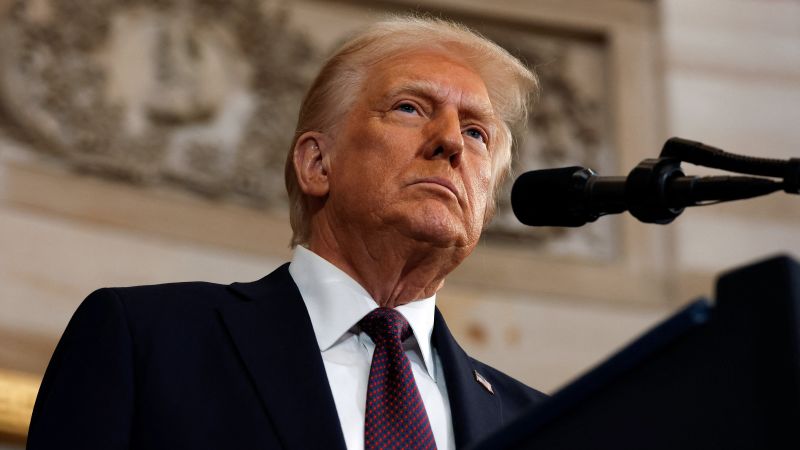
It has begun. March 04 signaled the first day of what could be a long and drawn out trade war between America and it's two closest neighbors and trading partners Canada and Mexico.
President Trump also doubled the tariff he slapped last month on Chinese products to 20%.
Markets are reeling, politicians are scrambling and the world is watching to see how the tariffs on Mexican and Canadian imports will affect consumers and the economy.
In Canada, the reaction was swift. Businesses pulled American bourbon, wine and other imported spirits from store shelves along. Canada also threatened to turn off imported power that keeps the lights on and factories running in states like Michigan, Minnesota and New York.
As well, Canadian Prime Minister, Justin Trudeau announced immediate retaliatory measures.
Trudeau said Canada will not back down from a fight in the face of "completely bogus and completely unjustified" trade action that has the potential to ruin bilateral relations and prompt job losses, economic devastation and higher inflation on both sides of the border. Trudeau has already slapped tariffs on an initial tranche of $30 billion worth of American goods and promised $125 billion more will face levies in three weeks' time. He said more, non-tariff measures are coming if Trump doesn't immediately back down. Trudeau said Trump is doing something "very dumb" by attacking Canada like this, given there will be serious ramifications for American workers and consumers with higher prices on everything from food, car parts and fertilizers to pharmaceuticals and paper products. March 04 CBC News Meanwhile, there have been some indicators that President Trump may be willing to negotiate.
President Donald Trump will “probably” announce tariff compromise deals with Canada and Mexico soon, Commerce Secretary Howard Lutnick said Tuesday. The potential agreements would likely involve scaling back at least part of Trump’s brand new 25% tariffs on imports from Mexico and Canada, he added. Lutnick’s comments came minutes after the U.S. stock market limped to a close for a second day of sharp declines, spurred at least in part by investors’ fears that Trump’s aggressive policies will ignite a crippling trade war. After his remarks, U.S. stock futures tied to all three major averages rose. The compromises with Canada and Mexico will likely be revealed as soon as Wednesday, Lutnick said on “Fox Business.” March 04CNBC News There's a lot of speculation out there and lingering questions:
What key American industries will benefit, which ones will suffer? When and will consumers see price hikes at the stores? Will there be a lasting negative impact felt on the American economy? What does this mean for the USMCA that was currently in place? If you're a journalist covering tariffs and the trade war then let us help.
William J. Luther, Ph.D., is an associate professor of economics at Florida Atlantic University, director of the American Institute for Economic Research’s Sound Money Project, and an adjunct scholar with the Cato Institute’s Center for Monetary and Financial Alternatives
William is available to speak with media. Simply click on his icon now to arrange an interview today
·
3 min
The threat of 25 % tariffs on Canada and Mexico had newsrooms buzzing, politicians scrambling and economists calculating who wins and who loses when trade wars break out among usually amicable neighbors. Factor in Greenland and China and the story went global.
It was a topic that headlined the news as many have watched and waited since the election for President Trump's first days in office to see what the country can expect with incoming policy changes.
President Donald Trump said in an Oval Office signing ceremony Monday evening that his administration will impose 25% tariffs on Mexico and Canada on February 1, an extraordinary change in North American trade policy that could raise prices for American consumers. Trump still outlined his broader trade policy for his second term in an executive action Monday. But that action — described by sources as a “placeholder” — doesn’t institute new global tariffs that Trump promised on Day One. As a candidate, Trump proposed sweeping and across-the-board tariffs: up to 20% on imports from all countries, with a 25% tax on goods from Mexico and Canada, plus a punishing 60% levy on goods from China. He also pledged to use tariffs as a negotiating tool on other countries, including, for example, Denmark — putting pressure on the European nation to give control of Greenland to the United States. Asked Monday at an Oval Office signing ceremony about tariffs on China, Trump noted extensive tariffs he imposed during his first administration were still in effect after former President Joe Biden largely left them in place. And on universal tariffs, Trump punted, saying, “We may, but we’re not ready for that just yet.” The executive action signed Monday directed the secretaries of Commerce and Treasury and the United States Trade Representative to investigate the causes of America’s trade deficits with foreign nations, to determine how to build an “External Revenue Service” to collect tariffs, to identify unfair trade practices and to review existing trade agreements for potential improvements. It also directs the government agencies to analyze how the US-Mexico-Canada trade agreement (the USMCA) signed by Trump in his first term is affecting American workers and businesses — and whether America should remain in the free trade agreement. January 21 CNN As business and political leaders in many countries, especially North America wait for what's ahead, there are questions to be asked:
What industries will be targeted? Will tariffs cause higher prices for consumers and increased inflation? Who wins if an all-out trade war happens? How will interwoven sectors like the auto industry and agriculture be impacted? If you're a journalist covering this ongoing story then let us help.
William J. Luther, Ph.D., is an associate professor of economics at Florida Atlantic University, director of the American Institute for Economic Research’s Sound Money Project, and an adjunct scholar with the Cato Institute’s Center for Monetary and Financial Alternatives
William is available to speak with media. Simply click on his icon now to arrange an interview today.
·
2 min
The years of high inflation appear to be over as inflation is now in line with the Federal Reserve’s target, though prices will likely remain permanently elevated, according to the Monthly Inflation Report produced by Florida Atlantic University’s College of Business. The Personal Consumption Expenditures Price Index (PCEPI), the Federal Reserve’s preferred measure of inflation, grew at a continuously compounding annual rate of 2.1% in September, up from 1.4% the prior month. Overall, PCEPI inflation has averaged 1.8% over the last three months and 2.1% over the last year.
“The good news is that the period of high inflation appears to be in the rearview mirror. The bad news is that prices remain permanently elevated,” said William J. Luther, Ph.D., associate professor of economics in FAU’s College of Business. “The PCEPI is about nine percentage points higher today than it would have been had inflation averaged 2% since January 2020. This unexpected burst of inflation transferred wealth from savers and employees to borrowers and employers.” Core inflation, which excludes volatile food and energy prices, remains elevated. Core PCEPI grew at a continuously compounding annual rate of 3% in September. It has averaged 2.3% over the last three months and 2.6% over the last year. High core inflation is partly due to housing services prices, which grew at a continuously compounding annual rate of 3.8% in September. “If the Fed were committed to price stability, it would have helped bring prices back down to a level consistent with pre-pandemic inflation,” Luther said. Fed officials have projected another 25 basis points worth of rate cuts this year, a much smaller change than is required to return the policy rate to neutral. Since the data shows inflation is back on track, Luther says they should move more quickly.
“As it stands, Federal Open Market Committee members intend to take some time reducing the policy rate to neutral, with policy likely to return to neutral sometime in 2026,” Luther said. “They might move more quickly if the economy shows signs of contraction or reduce the pace of rate cuts if they become concerned that inflation will pick back up.” William Luther, Ph.D., an assistant professor in FAU’s Economics Department, has expertise in economic growth, monetary policies, business cycles and cryptocurrencies. Luther’s research has obtained media interest across the nation, including recent coverage by The Wall Street Journal, Politico and Florida Trend.
If you're looking to know more let us help.
Simply click on William's icon now to set up an interview today.
Multimedia
Social
Biography
William J. Luther, Ph.D., is an associate professor of economics at Florida Atlantic University, director of the American Institute for Economic Research’s Sound Money Project, and an adjunct scholar with the Cato Institute’s Center for Monetary and Financial Alternatives. The Social Science Research Network currently ranks him in the top five percent of business authors. Luther has published articles in leading scholarly journals, including Journal of Economic Behavior & Organization, Economic Inquiry, Public Choice, Journal of Institutional Economics, Quarterly Review of Economics and Finance, and Contemporary Economic Policy. His work has been featured by major media outlets, including NPR, The Wall Street Journal, TIME Magazine, U.S. News & World Report, Fortune, National Review, The Guardian, POLITICO, and VICE News.
He earned his M.A. and Ph.D. in economics at George Mason University.
Applicant Tracking System (ATS) is screening job resumes: Use these tricks to beat it
NBC 5 WPTV tv
2025-10-01
Will Luther, an economics associate professor at Florida Atlantic University, acknowledged the concerns among students. "Absolutely, there are students very much concerned with whether or not they will be able to get a job when they finish here. The good news is that they will. The bad news is it's a little harder right now than it was, say, two years ago," Luther said.
How Donald Trump’s Tariffs Will Impact Florida: ‘Economic Hurricane’
Newsweek online
2025-04-04
William Luther, associate professor of economics at Florida Atlantic University, said that the immediate net financial loss to those in Florida, and all Americans, appears to be "very, very large."
Will Florida's DOGE Plans Lead To Savings? Economists Aren't Sold
MSN online
2025-02-27
William Luther, an associate professor of economics at Florida Atlantic University, told Newsweek that while it was still early to speculate, any potential savings from DeSantis' plans could be "relatively small" in relation to Florida's overall state budget
Tampa's inflation rate is now among the lowest compared to other metros
WUSF NPR online
2025-01-23
Nationally, the short-term increase in consumer prices — from 2.7% to 2.9% in December of 2024 — isn't likely to have consequences for federal policy, Florida Atlantic University economist William Luther said.
There’s a hidden recession red flag hidden in the latest jobs report, according to two top economists
Fortune online
2023-07-11
“This jobs report harbored the first indicator that the U.S. will slow down a lot, and by our forecast enter a recession, in the second half of 2023,” says Eugenio Aleman, chief economist for brokerage Raymond James. Adds Will Luther, an economics professor at Florida Atlantic University, “When the jobs numbers are suddenly pointing towards weakness and rapidly falling inflation, the Fed’s plans to keep over-tightening puts the economy on dangerous ground.”
How has Florida fared economically under DeSantis’ watch?
Tampa Bay Times online
2023-05-25
“Overall, I would say that Gov. DeSantis has been a good steward,” said William J. Luther, a Florida Atlantic University economist. “He inherited a well-performing state and has generally ensured that the state continues to work well for its residents.”
“Florida will not be immune to those consequences,” said William Luther, an economist and associate professor at Florida Atlantic University in Boca Raton.
WPBF 25 News spoke with Will Luther, Associate Professor of Economics at Florida Atlantic University, about what the interest rates mean for Floridians.
How Silicon Valley Bank bailout will be a financial burden for US bank customers
New York Post online
2023-03-13
But the fund gets its money in quarterly payments from FDIC-insured banks, which will likely make customers shoulder the burden of any added costs, said William Luther, director of the American Institute for Economic Research’s Sound Money Project.
Fed Raising Interest Rates Higher Than First Thought, Jerome Powell Tells Senate Committee
The Epoch Times online
2023-03-07
William Luther, the director of the American Institute for Economic Research's (AIER) Sound Money Project, was surprised by Democrats maintaining "a broken narrative on inflation." Senate Banking Committee Chair Sherrod Brown (D-Ohio) and some of his colleagues referenced Russia's invasion of Ukraine, the avian flu outbreak, corporate greed, and the supply chain crisis as reasons for rampant price inflation.
As new data shows inflation rose in January, here's what consumers can expect next
CNBC online
2023-02-24
"Inflation is going to come down gradually, if the Fed conducts policy the way it says it intends to," said William Luther, director of the American Institute for Economic Research's Sound Money Project.
The Federal Reserve Risks Setting an Inflation-Expectations Trap
National Review online
2021-11-03
September marked the fifth consecutive month of inflation at or above 4 percent. The Personal Consumption Expenditures Chain-type Price Index (PCEPI), the Fed’s preferred measure of the price level, grew 4.4 percent from September 2020 to September 2021. PCEPI inflation has averaged 2.98 percent on an annual basis since January 2020, just prior to the pandemic.
Ever since Iran was denied access in 2012 to the Society for Worldwide Interbank Financial Telecommunication, a Brussels-based global banking network known as Swift, the axis of evil and its allies have intensified their search for a way to move illicit money electronically, outside the legal banking system.
Generous federal benefits have prevented employment from recovering faster (“A Guaranteed Income At Work,” Review & Outlook, Aug. 11). But one should think twice before interpreting this as evidence against a universal basic income. UBI schemes pay people regardless of whether they work. Some of the Covid benefits, in contrast, are available only to those who are not working. Surely some of them would return to work if doing so didn’t require giving up the benefits.
Fifty years ago, President Richard Nixon closed the gold window, thereby preventing foreign governments from converting U.S. dollars into gold. This action was initially billed as a temporary measure. “I have directed Secretary Connally to suspend temporarily the convertibility of the dollar into gold or other reserve assets,” Nixon told a television audience.
It’s been five weeks since thousands across Cuba joined unprecedented protests against the 62-year-old communist regime. Yet Team Biden is still having trouble delineating a policy that actively supports the popular cry for self-governance. It’s enough to make one wonder if regime change is an administration priority.
President Richard Nixon ended the redeemability of dollars for gold and ushered in the fiat money era on Aug. 15, 1971. Many economists look back on the occasion with delight, agreeing with John Maynard Keynes that the gold standard was “a barbarous relic.” Today nearly all economists believe the U.S. economy has performed better under fiat money than it would have with the gold standard.
What to Do if There Isn’t COVID-19 Student Loan Forgiveness
Nerdwallet
2020-08-11
William J. Luther, director of the Sound Money Project at the nonpartisan nonprofit American Institute for Economic Research in Massachusetts, has previously called forgiveness bad policy. Even in light of recent events, he says “a student loan debt forgiveness policy does not target those who need it most.”
Florida throws open its doors — and holds its breath
Politico online
2020-05-18
According to new research from Florida Atlantic University economics professor William Luther, DeSantis can only take so much credit for Florida’s relatively good condition. Using Google Mobility, Luther found that local governments, business owners and citizens began social distancing before the DeSantis issued orders March and April. Roughly three-quarters of the change in residential, retail, recreation, workplace and public transportation activity preceded orders by states to shelter in place.
Venezuelan dictator Nicolás Maduro is again unleashing armies of inspectors across the country to enforce price controls as a means of controlling hyperinflation, the Venezuelan newspaper Tal Cual reported last week.
In The Curse of Cash, Kenneth Rogoff lists reductions in criminal activity and tax evasion among the primary benefits of eliminating cash. We maintain that, to the extent that individuals are interested in purchasing illicit goods and services or evading taxes, eliminating cash will encourage them to switch to close substitutes. Hence, governments intent on realizing the benefits cited by Rogoff would not merely need to eliminate cash. They would also need to ban alternatives. This is especially relevant given the proliferation of cryptocurrencies, which provide a fair degree of anonymity for users.
The Federal Reserve's response to the COVID-19 contraction: An initial appraisal
Southern Economic Journal
2021
We provide an initial assessment of the Federal Reserve's policy response to the COVID-19 contraction. We briefly review the historical episode and consider the standard textbook treatment of a pandemic on the macroeconomy. We summarize and then evaluate the Fed's monetary and emergency lending policies through the end of 2020. We credit the Fed with promoting monetary stability while maintaining that it could have done more. We argue that the Fed could have achieved stability without employing its emergency lending facilities. Although some facilities likely helped to promote general liquidity, others were primarily intended to allocate credit, which blurs the line between monetary and fiscal policy. These credit allocation facilities were unwarranted and unwise.
Central bank independence and the Federal Reserve's new operating regime
The Quarterly Review of Economics and Finance
2020
The Federal Reserve is exposed to a greater degree of political influence under its new operating regime. We survey the relevant literature and describe the Fed's new operating regime. Then we explain how the regime change reduced de facto central bank independence. In brief, the regime change increased the appointment power of the President and improved the bargaining power of Congress. We offer some suggestions for bolstering de facto independence at the Fed.
We make a distinction between centralized, decentralized, and distributed payment mechanisms. A centralized payment mechanism processes a transaction using a trusted third party. A decentralized payment mechanism processes a transaction between the parties to the transaction.
In a recent article, Yermack (2015) argues that bitcoin is not money because it functions poorly as a medium of exchange, unit of account, and store of value. We offer a more conventional view. We maintain that the standard approach classifies an item as money if and only if it functions as a commonly-accepted medium of exchange.
What or who governs central bank decisions? Most considerations focus on motivations. Instead, we consider the extent to which specific behaviors have adaptive value in the context of central banking. From that perspective, poor decisions are not the product of poor motivations.
By declaring an item legal tender or making it publicly receivable, governments might generate sufficient demand to determine the medium of exchange. How do private actors launch a new money? There are two views in the literature. The first requires offering an item with a use value to some agents that is distinct from its role as a medium of exchange. The second suggests that agents might coordinate on an intrinsically useless item. With these views in mind, I survey the logs from the original bitcoin forum, bitcoin-list. I find that early participants in the bitcoin community understood the importance of coordination and took steps to coordinate users.
On March 16, 2013, Cyprus announced that it would accept a bailout that required imposing a one-time levy on bank deposits. It has been argued that, by making traditional deposit accounts seem less secure, the bailout announcement prompted some to consider—or reconsider—using the cryptocurrency bitcoin. Relying on rank data for a subset of apps, existing studies maintain that interest in bitcoin increased following the announcement, especially in countries with troubled banks. We argue that (1) focusing on a subset of apps does not allow one to distinguish a general increase in the demand for bitcoin apps from a substitution between bitcoin apps and (2) changes in rank data are a poor predictor of changes in the number of downloads. In order to address these concerns, we collect rank data for all fifteen bitcoin apps available at the time and use an established technique to estimate an index of downloads for each country considered. We find that, while downloads of bitcoin apps increased following the announcement, the observed effect was not especially pronounced in countries thought to have had troubled banking systems at the time.
We employ a monetary model with endogenous search and random consumption preferences to consider the extent to which a government can ban an alternative currency, like bitcoin. We define a ban as a policy whereby government agents refuse to accept an alternative currency and mete out punishments to private agents caught using it. After identifying monetary equilibria where an alternative currency is accepted, we then derive the conditions under which a ban might deter its use. As in earlier studies, we show that a government of sufficient size can prevent an alternative currency from circulating without relying on punishments. We also show that, given its size, a government can ban an alternative currency so long as it is willing and able to mete out sufficiently severe punishments.
The recent proliferation of bitcoin has been a boon for users but might pose problems for governments. Indeed, some governments have already taken steps to ban or discourage the use of bitcoin. In a model with endogenous matching and random consumption preferences, we find multiple monetary equilibria including one in which bitcoin coexists with official currency. We then identify the conditions under which government transactions policy might deter the use of bitcoin. We show that such a policy becomes more difficult if some users strictly prefer bitcoin because they can avoid other users holding the official currency in the matching process.
Cryptocurrencies, Network Effects, and Switching Costs
Contemporary Economic Policy
2015
Cryptocurrencies are digital alternatives to traditional government-issued paper monies. Given the current state of technology and skepticism regarding the future purchasing power of existing monies, why have cryptocurrencies failed to gain widespread acceptance? I offer an explanation based on network effects and switching costs. In order to articulate the problem that agents considering cryptocurrencies face, I employ a simple model developed by Dowd and Greenaway (1993) (Dowd, K., and D. Greenaway. “Currency Competition, Network Externalities, and Switching Costs: Towards an Alternative View of Optimum Currency Areas.” The Economic Journal, 103(420), 1993, 1180–89). The model demonstrates that agents may fail to adopt an alternative currency when network effects and switching costs are present, even if all agents agree that the prevailing currency is inferior. The limited success of bitcoin—almost certainly the most popular cryptocurrency to date—serves to illustrate. After briefly surveying episodes of successful monetary transition, I conclude that cryptocurrencies like bitcoin are unlikely to generate widespread acceptance in the absence of either significant monetary instability or government support.